On a wintry November evening I was out with my camera looking for birds. You might think that by this time of year most migratory birds would already have set off for the south – but that was not the case. The northern bald ibises, a critically endangered ibis species, were late this year and should actually have started their journey across the Alps in September or October.
In autumn these birds usually migrate from their breeding grounds in Central Europe across the Alps to South Tyrol and on to Tuscany, where they spend the winter. Switzerland lies on their flight path. Because winter weather set in early, however, they found it difficult to find suitable thermals over the Alps – an important prerequisite for their energy-efficient flight.
The northern bald ibis was once widespread in large parts of Europe, but died out in Central Europe in the 17th century – mainly due to intensive hunting and loss of habitat. Only thanks to scientifically supervised reintroduction projects such as the “Waldrappteam” is it possible today for these birds to breed in Europe again. Some of the animals are hand-reared and fitted with GPS transmitters to track their movements. Young birds even have to learn the way south first. To do this, specially trained people accompany them across the Alps in microlight aircraft. The aim is for the offspring to learn the migration route on their own and later to winter and breed as wild animals.
That I was able to spot this endangered species that evening borders on a miracle. Without the reintroduction projects, such an encounter would hardly have been possible. The birds were in a field looking for food. I watched as a northern bald ibis skilfully pulled a worm out of the ground and swallowed it.
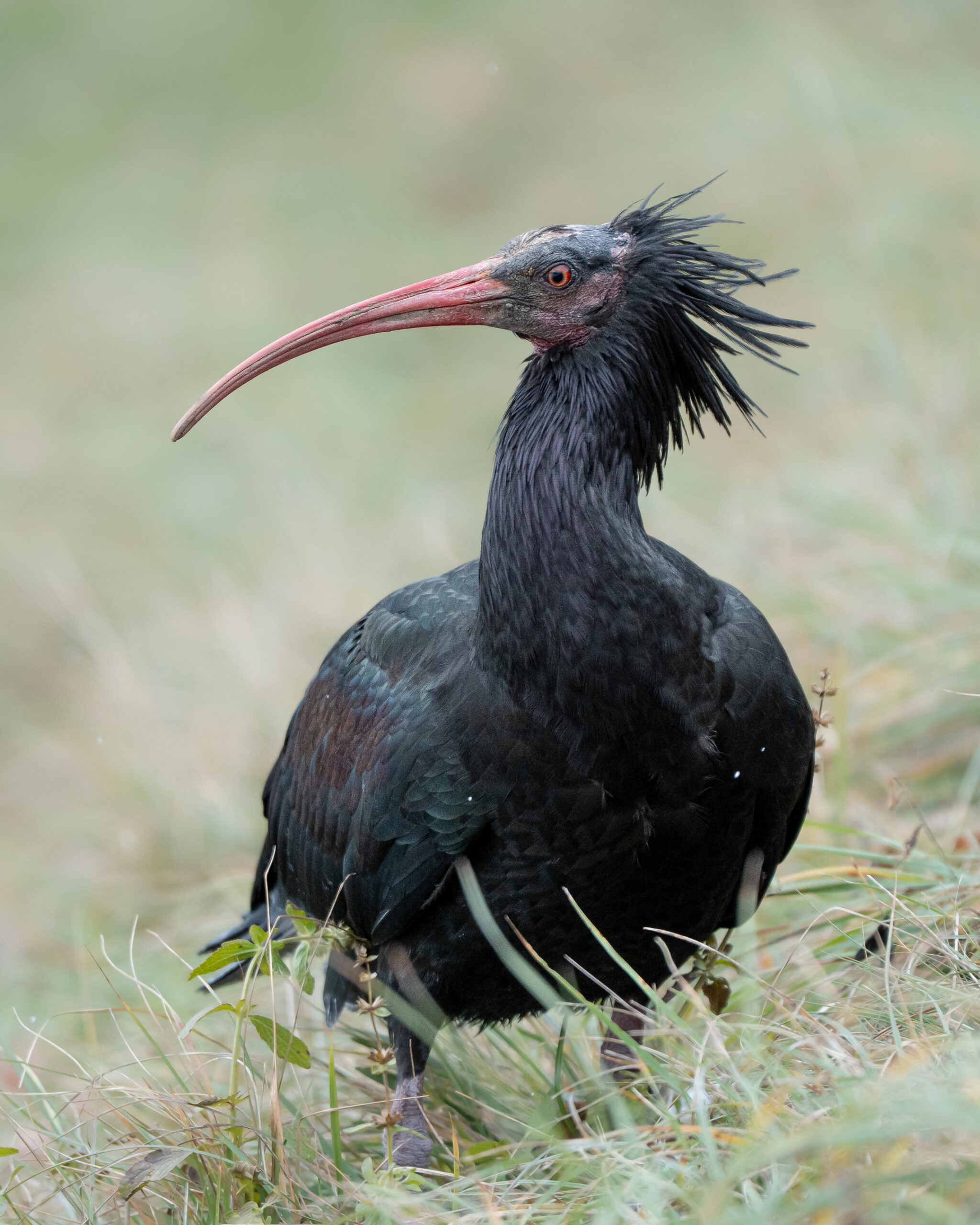
Northern Bald Ibis (Geronticus eremita) // 1/1000 sec | f/6.3 | ISO 2000 | 600 mm
At first I was still some distance away, but suddenly the whole group flew in my direction and landed right in front of me. They had probably not found enough food at their previous spot and were therefore looking for a new place. I was completely surprised at how little shy they were. Almost undisturbed, they continued looking for food in front of my eyes. They were obviously already used to people. This allowed me to photograph a northern bald ibis at close range.
I am particularly fascinated by this bird because of its curved bill – a feature that only a few other bird species in Switzerland have. The jet-black, slightly metallic plumage and the bare red skin on its head also make it unique for me.
Satisfied, I ended my photography and wanted to leave the animals in peace for the evening. Above all, I wished them a safe and successful journey to the warmer south.
Sources:
- home en – Waldrapp. (2025, April 10). Waldrapp. https://www.waldrapp.eu/en/
- Waldrappteam. (2025, April 7). Waldrappteam. https://www.waldrappteam.at/en/
- Swiss Ornithological Institute. (2024, October 23). Vogelarten: Waldrapp [in German]. https://www.vogelwarte.ch/de/voegel-der-schweiz/waldrapp/
Leave a Reply